_副本.png)
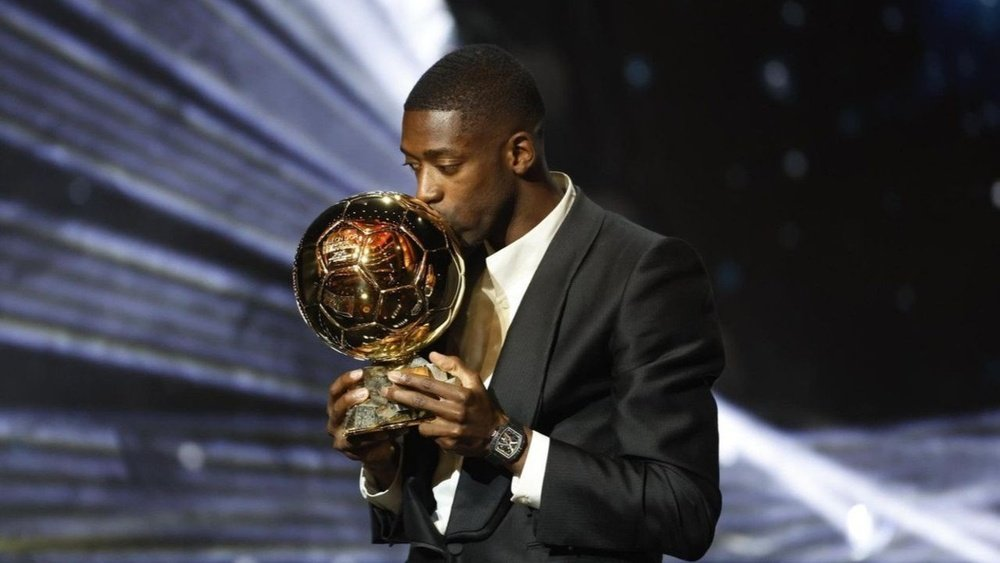
Fresh from a second Champions League triumph and clutching the Ballon d’Or, Ousmane Dembele heads to the 2026 World Cup in the form of his life. We examine the chequered history of those who arrived on the world stage as the planet’s pre-eminent player.
On September 22nd, 2025, Ousmane Dembele etched his name into French footballing folklore. By claiming the Ballon d’Or, he became the sixth French player to secure the sport’s ultimate individual accolade, following in the illustrious footsteps of Raymond Kopa, Michel Platini (a three-time winner), Jean-Pierre Papin, Zinedine Zidane, and Benzema.
It was a deserved tribute to a truly extraordinary campaign. Repurposed as a false nine by Luis Enrique and yielding 35 goals and 15 assists, Dembele spearheaded a clean sweep for PSG: Ligue 1, the Coupe de France and, most crucially, the first Champions League in the Parisian club’s history.
“It is an exceptional trophy for a footballer. The Ballon d’Or is the Holy Grail,” he declared on August 28, shortly before receiving the award.
Fast forward one year, and PSG have just retained their European crown in Budapest against Arsenal. Despite a season punctuated by injury, Dembele remained the man for the big occasion. With 8 goals and 2 assists in 13 Champions League matches this term, he now heads to the World Cup with France in imperious form.
However, a curious omen haunts the history books. Since the Ballon d’Or’s inception, not a single winner has gone on to lift the World Cup immediately after their coronation. It is a curse that has spared not even the game’s most iconic figures. Dembele, leading a France side that ranks among the tournament favourites, now has the opportunity to break that long-standing hoodoo.
Since the award was established in 1956, seventeen World Cups have been contested. Among them, three editions stand as outliers where the reigning Ballon d’Or holder simply did not feature.
In 1958, Alfredo Di Stefano missed the tournament following Spain’s failure to qualify. In 1978, the same fate befell Simonsen after Denmark failed to make the cut. Finally, in 2022, Benzema was denied the chance to challenge fate. Crowned just weeks earlier, he withdrew on the eve of the Qatar World Cup, a victim of an injury that robbed Francia of their best player.
Sivori and Cristiano: Early casualties in the group stage
Omar Sivori was the first Ballon d’Or winner to suffer an early exit. Crowned in 1961, the Italo-Argentine arrived in Chile in 1962 as the world’s finest but was sent packing in the first round with Italy. The Azzurri finished third in their group behind Alemania and the hosts, exiting alongside Switzerland.
Cristiano Ronaldo endured a similar nightmare in 2014 in Brazil. As the reigning Ballon d’Or holder, the Portuguese icon was unable to drag a limited squad past Alemania and the United States. Eliminated on goal difference, CR7 departed without leaving his usual mark on the grandest stage.
Van Basten and Cristiano: Halted in last 16
Marco Van Basten landed in Italy ’90 clutching his second Ballon d’Or. However, the prolific Dutchman could not translate his club dominance to the Netherlands. The ‘Oranje’, then European champions, were dumped out in the Round of 16 by West Germany (2-1), who went on to lift the trophy.
Cristiano Ronaldo saw history repeat itself in 2018. Having added three more Golden Balls to his collection since 2014, the outcome in Russia was only marginally better. Despite a stunning hat-trick against Spain, he was thwarted in the Round of 16 by Uruguay (2-1).
Owen, Ronaldinho and Messi: Quarter-final heartbreak
Michael Owen entered the 2002 World Cup as the 2001 Ballon d’Or recipient. Though he drew first blood against Brazil in the quarter-finals, Owen and England were undone by Ronaldinho’s audacious 30-yard free-kick, ending their journey prematurely.
Ronaldinho himself arrived in Alemania 2006 as the world’s premier player. At the zenith of his powers with Barca, he was the tournament’s poster boy. Yet the magic faded; the Selecao were outclassed in the quarters by a Zidane-inspired Francia, marking one of Brazil’s most bitter disappointments.
Lionel Messi met a similar fate in South Africa 2010. Having won the first of his many Ballon d’Ors, the Argentina star spearheaded a side coached by Maradona. However, the Albiceleste crumbled in the quarter-finals, suffering a humbling 4-0 defeat to Alemania.
Eusebio and Michel Platini: Fallen at the penultimate hurdle
The 1965 Ballon d’Or winner, Eusebio, the ‘Black Panther’, enjoyed a stellar tournament in 1966. Finishing as top scorer in England with nine goals, he propelled Portugal to the semi-finals before falling to the hosts. The Lusitanians eventually settled for third.
Michel Platini followed a similar path in Mexico ’86. A three-time consecutive Ballon d’Or winner, the Francia captain fell in the semi-finals against West Germany (2-0). Though they secured bronze, the sense of missed opportunity was profound.
Rivera, Cruyff, Rummenigge, Baggio and Ronaldo: The five defeated finalists
Gianni Rivera was the first to come within touching distance. The 1969 Ballon d’Or winner and Milan icon led Italy to the 1970 final in Mexico, only to be brushed aside 4-1 by Pele’s Brazil.
Orchestrated by 1973 Ballon d’Or winner Johan Cruyff, the Netherlands and their ‘Total Football’ reached the 1974 final. But hosts Alemania fought back to win 2-1, despite the Dutch scoring a penalty in the opening minute.
Karl-Heinz Rummenigge suffered the same agony in 1982. The two-time reigning Ballon d’Or holder saw his side fall in the final to an inspired Italy led by Paolo Rossi (3-1).
Roberto Baggio, the 1993 winner, remains the most poignant figure. His skied penalty in the 1994 final against Brazil—head bowed in despair—is etched into World Cup legend.
Finally, Ronaldo, crowned the world’s best in 1997 at just 21, dazzled with 4 goals and 3 assists in 1998 before a mysterious pre-match seizure. Though he started the final, he was a shadow of himself as Francia cruised to a 3-0 victory at the Stade de France.